
AI Is Making Developers Faster. It May Also Be Making Releases Riskier
Updated: Jul 30

AI adoption in software development is no longer experimental. DORA reports that 89% of organisations are prioritising AI integration, while 76% of technologists already use AI in some part of their daily work. The productivity signal is real.
Developers using generative AI report improvements in productivity, flow, and job satisfaction. DORA also found positive associations with code quality, documentation quality, and code-review speed. But there is another side to the data. A 25% increase in AI adoption was associated with 7.2% lower delivery stability and 1.5% lower delivery throughput.
More AI. Better individual productivity. But delivery performance is weaker.
AI does not necessarily break the pipeline. It can expose its limits
DORA’s proposed explanation is straightforward. When developers produce code faster, change volumes and batch sizes can grow. Larger changes are harder to review, test, and release safely. The improvement at the individual level creates additional pressure at the system level.
Many delivery systems were not designed to absorb that increase. Improving how quickly code is created does not automatically improve how safely and reliably it reaches production.
That still depends on familiar engineering fundamentals:
Small batch sizes
Continuous integration
Automated testing
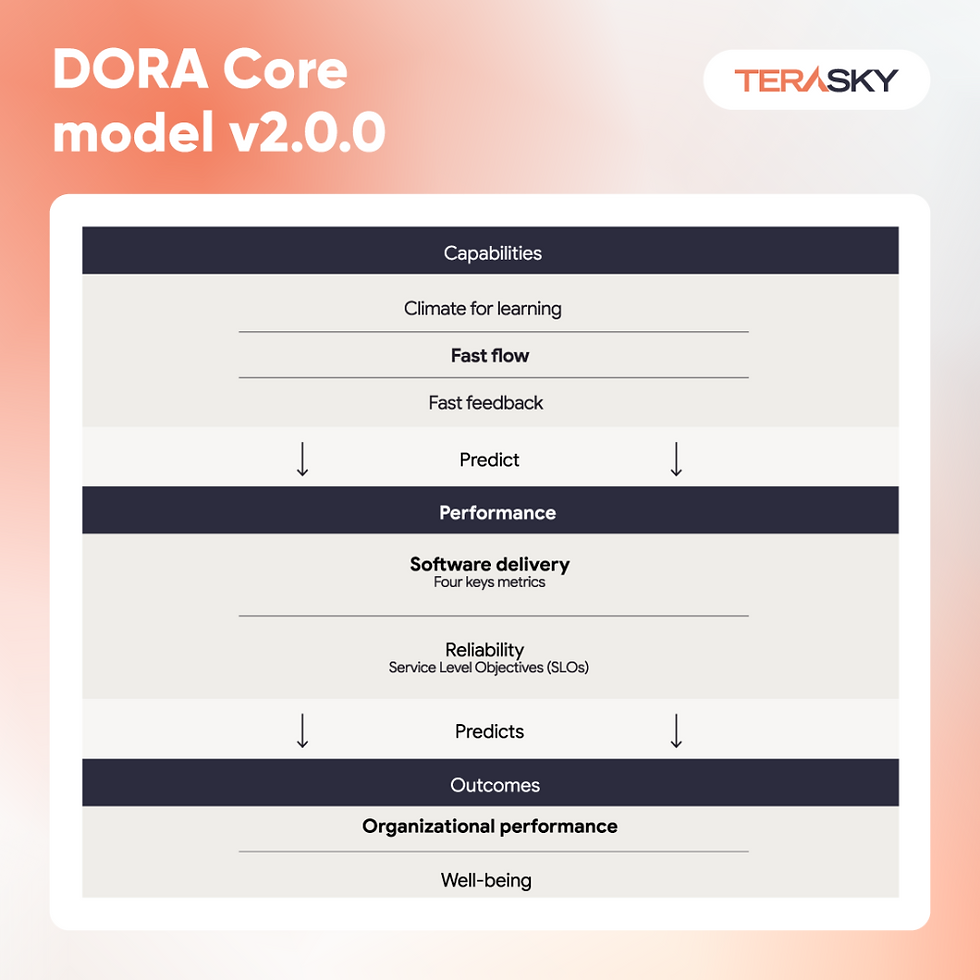
Fast feedback
Reliable deployment processes
AI does not replace these capabilities. It makes them more important.
The valuable-work paradox
DORA also found that heavier AI adoption was associated with developers spending less time on work they considered valuable, while time spent on repetitive or toilsome work remained largely unchanged.
The report describes this as the vacuum hypothesis. AI may accelerate meaningful development tasks, creating additional capacity. But that capacity is not automatically redirected toward architecture, experimentation, or creative problem-solving. Meetings, bureaucracy, and slow organisational processes remain. This creates a broader leadership question: Are developers simply producing more output, or is the organisation converting that additional capacity into better outcomes?
AI adoption is an architecture decision
The organisations most likely to benefit from AI will not treat it as an isolated developer tool.
They will strengthen the system around it:
Trusted CI and test pipelines
Small, reviewable changes
Clear AI-use policies
Dedicated learning time
Fast technical and organisational feedback loops
Clear ownership of code and production outcomes
DORA’s research indicates that clear acceptable-use policies, dedicated learning time, and strong feedback mechanisms can support more effective AI adoption.
The question engineering leaders should ask
Imagine that every developer on your team produced significantly more code starting Monday.
Would your delivery architecture safely absorb it?
Would testing scale?
Would reviews remain effective?
Would releases stay routine?
If the answer is uncertain, the priority is not simply adopting more AI. It is designing the engineering system that enables AI-generated productivity to become a reliable source of business value. AI can be a genuine multiplier. But it multiplies the capabilities and the constraints already present in your delivery system.
Source: Google Cloud DORA, Impact of Generative AI in Software Development.


